 Skip to content
Steel structures are widely used in construction, infrastructure, bridges, industrial facilities, storage tanks, warehouses, and manufacturing plants. However, before steel can be painted or coated, its surface must be properly prepared. Rust, mill scale, old coatings, dirt, oil, and other contaminants can significantly reduce coating adhesion and shorten the service life of the structure.
Shot blasting for steel structures is one of the most effective methods for preparing steel surfaces before painting and protective coating. By using abrasive media propelled at high velocity, shot blasting removes surface contaminants and creates the required surface profile for strong and durable coating adhesion.
In this comprehensive guide, we explain how shot blasting works, why it is important for steel construction, the most common surface preparation grades, abrasive selection, equipment components, maintenance requirements, and the role of shot blast machine spare parts in maintaining consistent blasting performance.
What Is Shot Blasting for Steel Structures?
Shot blasting is a mechanical surface preparation process in which abrasive particles are accelerated toward a steel surface at high speed. The impact of the abrasive removes unwanted materials and creates a controlled surface texture.
Depending on the application, the abrasive can include steel shot, steel grit, or other suitable blasting media.
For steel structures, shot blasting is commonly used to remove:
- Mill scale
- Rust and corrosion
- Old paint and coatings
- Welding residues
- Dirt and surface contamination
- Oxidation
- Loose particles
- Manufacturing residues
The resulting surface is cleaner, rougher, and more suitable for the application of primers, paints, powder coatings, or other protective systems.
Why Is Surface Preparation Important Before Painting Steel?
Applying paint or protective coating directly onto contaminated or poorly prepared steel can lead to premature coating failure.
Even high-quality coatings cannot perform effectively if the substrate is not properly prepared.
Proper steel surface preparation helps:
- Improve coating adhesion
- Remove corrosion and mill scale
- Reduce the risk of premature coating failure
- Increase coating service life
- Create a consistent surface profile
- Improve the appearance of the finished structure
- Reduce maintenance and repainting costs
For this reason, surface preparation is often considered one of the most important stages of a steel painting and coating system.
How Does Shot Blasting Prepare Steel for Painting?
The shot blasting process typically involves several stages.
1. Loading the Steel Structure
Depending on the size and geometry of the workpiece, steel components may be placed inside a blast cabinet, on a roller conveyor, on a hook system, or on another specialized handling system.
Large structural components such as beams, columns, plates, pipes, and fabricated assemblies may require specialized continuous or automated blasting equipment.
2. Abrasive Acceleration
The abrasive media is accelerated toward the steel surface.
In wheel-blast machines, a high-speed blast wheel throws the abrasive onto the workpiece. The velocity and quantity of abrasive determine the intensity and productivity of the blasting operation.
3. Removal of Contaminants
The impact energy of the abrasive breaks away rust, mill scale, old coatings, and other contaminants.
The effectiveness of the process depends on several factors, including:
- Abrasive type
- Abrasive size
- Blast wheel speed
- Abrasive flow rate
- Blast angle
- Exposure time
- Surface condition
- Machine configuration
4. Creation of a Surface Profile
Shot blasting does more than simply clean the steel.
It also creates a controlled surface profile, which increases the effective bonding area between the steel substrate and the coating.
This profile is particularly important for protective coating systems used in aggressive environments.
5. Abrasive Recovery and Cleaning
After blasting, the abrasive and removed contaminants are collected and separated.
Modern shot blasting machines typically use recovery systems, bucket elevators, screw conveyors, air-wash separators, and dust collectors to recycle usable abrasive and remove contaminants.
Shot Blasting vs. Other Steel Surface Preparation Methods
Shot blasting is not the only method used for steel surface preparation. The appropriate technique depends on the project requirements, steel condition, production volume, and coating specification.
| Surface Preparation Method | Main Application | Advantages | Limitations |
|---|---|---|---|
| Shot Blasting | Steel structures and fabricated components | Fast, consistent, automated | Requires specialized equipment |
| Grit Blasting | Heavy corrosion and aggressive cleaning | Strong surface preparation | Higher abrasive consumption in some applications |
| Sandblasting | General abrasive cleaning | Traditional and versatile | Silica dust can create serious health risks |
| Wire Brushing | Small areas and touch-up work | Simple and inexpensive | Low productivity |
| Grinding | Welds and localized defects | Effective for specific areas | Labor intensive |
| Chemical Cleaning | Specific contaminants | Useful for selected applications | Chemical handling requirements |
| Hand Tool Cleaning | Small repair areas | Low equipment requirements | Limited cleaning efficiency |
For large-scale steel fabrication, automated shot blasting can provide significant productivity and consistency advantages.
What Surface Preparation Grade Is Required?
Steel surface preparation is commonly specified according to recognized standards such as ISO 8501-1.
Common preparation grades include:
- Sa 1 – Light blast-cleaning
- Sa 2 – Thorough blast-cleaning
- Sa 2½ – Very thorough blast-cleaning
- Sa 3 – Blast-cleaning to visually clean steel
For many demanding industrial coating systems, Sa 2½ is commonly specified.
However, the correct preparation grade should always be determined according to the coating manufacturer’s technical requirements, project specifications, environmental conditions, and applicable standards.
Sa 1: Light Blast-Cleaning
Loose mill scale, rust, and foreign materials are removed. Some firmly attached contaminants may remain.
Sa 2: Thorough Blast-Cleaning
Most mill scale, rust, and foreign matter are removed, leaving a significantly cleaner surface.
Sa 2½: Very Thorough Blast-Cleaning
The steel surface is cleaned to a high standard, with only minor traces of contamination permitted according to the applicable standard.
Sa 3: Blast-Cleaning to Visually Clean Steel
The highest level of blast cleaning, producing a visually clean metallic surface.
Why Is Sa 2½ Important for Steel Construction?
Sa 2½ is frequently specified for steel structures because it provides a high degree of surface cleanliness while creating an appropriate substrate for many protective coating systems.
A properly prepared Sa 2½ surface can help:
- Improve primer adhesion
- Reduce corrosion-related coating failure
- Increase coating durability
- Provide consistent surface quality
- Support long-term corrosion protection
Nevertheless, achieving Sa 2½ does not depend only on machine operation. Abrasive condition, steel condition, contamination control, and operator or process parameters also play important roles.
Surface Profile: An Important Part of Steel Preparation
Surface cleanliness is only one part of successful coating preparation.
The steel surface also needs an appropriate surface profile, sometimes referred to as anchor profile or surface roughness.
Abrasive impact creates microscopic peaks and valleys on the steel. The coating flows into these irregularities and forms a mechanical bond with the substrate.
An insufficient profile may reduce coating adhesion, while an excessively aggressive profile can increase coating consumption and potentially create other coating problems.
The required profile should therefore be selected according to the coating system and project specification.
Choosing the Right Abrasive for Steel Shot Blasting
Abrasive selection has a major impact on blasting efficiency, surface profile, machine wear, and final surface quality.
Common metallic abrasives include:
Steel Shot
Steel shot consists of spherical steel particles.
It is commonly used for:
- General cleaning
- Removing mill scale
- Surface conditioning
- High-production blasting
- Applications where a relatively controlled impact is required
Steel Grit
Steel grit has an angular shape and generally provides a more aggressive cutting action.
It can be suitable for:
- Heavy rust removal
- Mill scale removal
- Tough coatings
- Applications requiring a more pronounced surface profile
Shot and Grit Mixtures
Some applications use a controlled mixture of shot and grit to achieve a balance between cleaning performance, surface profile, abrasive life, and machine productivity.
Factors That Affect Shot Blasting Performance
The quality of a shot blasting operation depends on more than simply selecting the correct abrasive.
Important factors include:
Blast Wheel Speed
Higher wheel speed generally increases abrasive velocity and impact energy. However, excessive speed can increase machine wear and abrasive breakdown.
Abrasive Flow Rate
The amount of abrasive delivered to the blast wheel affects cleaning efficiency and production rate.
Abrasive Size
Large particles can provide greater impact energy and a deeper profile, while smaller particles may provide different cleaning and surface-finishing characteristics.
Abrasive Condition
Broken-down or contaminated abrasive can reduce blasting efficiency and increase dust generation.
Exposure Time
The workpiece must receive sufficient blasting coverage to achieve the required cleanliness and profile.
Blast Pattern
The position and orientation of the blast wheel are critical for achieving uniform coverage, particularly on complex structural components.
Main Components of a Shot Blasting Machine
Understanding the major components of a shot blasting machine is important when selecting maintenance parts and diagnosing performance problems.
| Component | Function |
|---|---|
| Blast Wheel | Accelerates abrasive toward the steel surface |
| Impeller | Feeds abrasive into the blasting system |
| Control Cage | Controls abrasive direction and distribution |
| Blades | Accelerate and propel abrasive |
| Wear Plates | Protect internal machine surfaces |
| Screw Conveyor | Moves recovered abrasive |
| Bucket Elevator | Transfers abrasive vertically |
| Separator | Separates reusable abrasive from dust and debris |
| Dust Collector | Removes airborne dust |
| Blast Cabinet | Contains the blasting operation |
| Conveyor System | Transports steel components |
| Abrasive Valves | Control abrasive flow |
| Bearings | Support rotating components |
| Seals | Help prevent abrasive and dust leakage |
The Importance of Shot Blast Spare Parts
A shot blasting machine operates in a highly abrasive environment. Components exposed directly or indirectly to abrasive media can experience significant wear.
For this reason, high-quality shot blast spare parts are essential for maintaining machine performance.
Common replacement parts include:
- Blast wheel blades
- Impellers
- Control cages
- Wear plates
- Liner plates
- Bearing assemblies
- Seals
- Conveyor components
- Bucket elevator components
- Abrasive flow control components
- Fasteners
- Protective liners
Using worn components for too long can negatively affect blasting performance and may increase operating costs.
Why Blast Wheel Blades Wear Out
Blast wheel blades are among the most critical wear parts in many wheel-blast machines.
They are continuously exposed to high-speed abrasive particles. Over time, the abrasive impact gradually changes the blade geometry.
Worn blades can result in:
- Reduced blasting efficiency
- Irregular abrasive distribution
- Higher energy consumption
- Poor surface preparation
- Uneven blast patterns
- Increased risk of equipment damage
Regular inspection and timely replacement help maintain consistent abrasive velocity and blast coverage.
Control Cage and Impeller Maintenance
The control cage and impeller play important roles in directing abrasive into the correct part of the blast wheel.
If these components become worn, the abrasive may not enter the wheel correctly.
Potential consequences include:
- Uneven abrasive distribution
- Reduced cleaning efficiency
- Increased wheel vibration
- Excessive wear
- Poor surface coverage
Maintenance intervals should be based on machine operating hours, abrasive type, production conditions, and manufacturer recommendations.
Shot Blast Machine Liners and Wear Plates
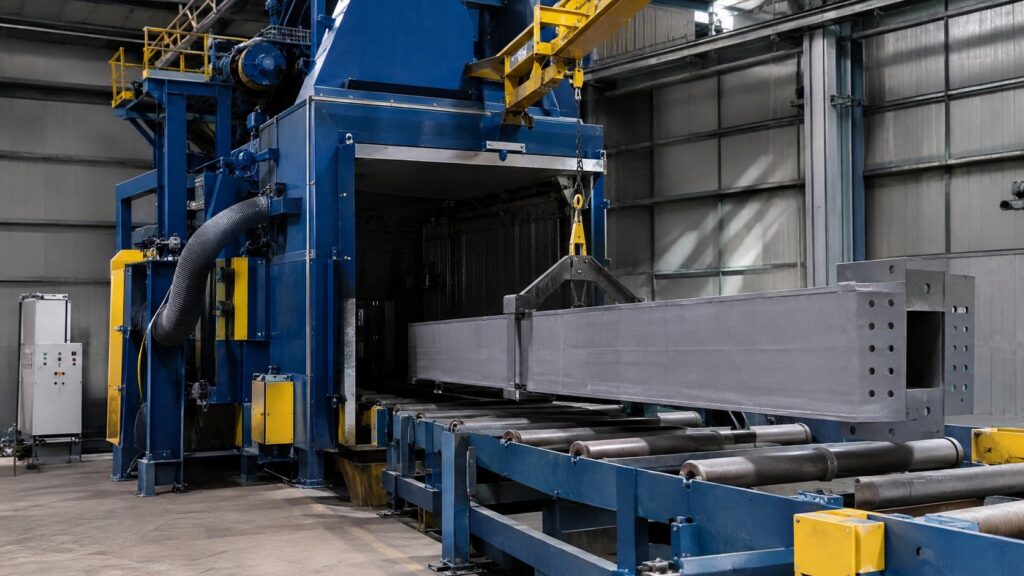
The internal surfaces of a blast machine are exposed to abrasive particles and therefore require protection.
Liner plates and wear plates protect the blast cabinet and other critical areas from abrasive erosion.
Depending on the machine design, liners may be manufactured from abrasion-resistant steel or other wear-resistant materials.
Regular inspection is important because a damaged liner can expose the machine body to direct abrasive impact.
Abrasive Recycling and Separation
One of the major advantages of industrial wheel-blast systems is the ability to recover and reuse abrasive.
After blasting, the mixture of abrasive, rust, mill scale, dust, and broken particles is collected and transported through the recovery system.
The separator removes unsuitable material while allowing reusable abrasive to return to the blasting system.
An effective abrasive recovery system can help:
- Reduce abrasive consumption
- Improve blasting consistency
- Reduce waste
- Control dust
- Lower operating costs
Dust Collection in Steel Shot Blasting
Shot blasting generates dust from removed rust, mill scale, broken abrasive, and surface contaminants.
A properly designed dust collection system is therefore essential for:
- Worker safety
- Visibility inside the machine
- Environmental control
- Abrasive separation
- Machine cleanliness
- Stable blasting performance
Dust collector filters and related components should be inspected and maintained according to the equipment manufacturer’s recommendations.
Common Problems During Shot Blasting of Steel Structures
Uneven Surface Preparation
Possible causes include:
- Incorrect blast wheel positioning
- Worn blades
- Incorrect abrasive flow
- Inadequate exposure time
- Poor workpiece positioning
Excessive Abrasive Consumption
Potential causes include:
- Poor separator adjustment
- Excessive abrasive breakdown
- Incorrect abrasive selection
- Leakage from the machine
- Inefficient recovery
Excessive Dust
Possible causes include:
- Incorrect separator settings
- Contaminated abrasive
- Damaged filters
- Poor dust collection airflow
- Excessive abrasive breakdown
Poor Coating Adhesion After Blasting
Potential causes include:
- Insufficient surface cleanliness
- Incorrect surface profile
- Flash rust
- Oil contamination
- Delayed coating application
- Environmental conditions outside coating specifications
High Machine Wear
Potential causes include:
- Incorrect abrasive size
- Excessively aggressive abrasive
- Worn liners
- Poor abrasive separation
- Incorrect wheel settings
- Continuous operation with damaged wear components
How to Improve Shot Blasting Efficiency
A systematic maintenance and process-control program can significantly improve shot blasting performance.
1. Inspect Wear Parts Regularly
Check blades, control cages, impellers, liners, seals, and other wear components.
2. Maintain Correct Abrasive Mixture
Abrasive size distribution should remain within the recommended operating range.
3. Keep the Separator Properly Adjusted
The separator should effectively remove dust, fines, and broken abrasive without unnecessarily discarding usable media.
4. Monitor Blast Wheel Condition
Wheel components should be inspected for wear, damage, imbalance, and abnormal vibration.
5. Replace Damaged Components Promptly
Continuing operation with severely worn parts can cause secondary damage to other machine components.
6. Maintain the Dust Collector
Blocked or damaged filters can reduce airflow and negatively affect machine operation.
7. Follow the Equipment Manufacturer’s Specifications
Machine-specific operating parameters should always take priority over generic recommendations.
Shot Blasting for Different Steel Construction Applications
Shot blasting is used across many areas of steel fabrication and construction.
Structural Steel Beams
I-beams, H-beams, channels, and other structural profiles can be blast cleaned before priming and painting.
Steel Plates
Steel plates are often processed using automatic blast machines before fabrication or coating.
Steel Pipes
Pipes can require specialized internal or external blasting systems depending on their dimensions and coating requirements.
Bridges
Bridge components require reliable corrosion protection because they are exposed to weather, moisture, salts, and changing environmental conditions.
Storage Tanks
Tank components may be blast cleaned before protective coating systems are applied.
Industrial Buildings
Columns, trusses, beams, and fabricated components can be prepared before painting or fire-protection coating.
Heavy Equipment and Machinery
Steel machine frames and fabricated parts can also be shot blasted to remove scale and prepare surfaces for coating.
Shot Blasting and Corrosion Protection
Corrosion is one of the primary threats to steel structures.
A properly designed coating system provides a barrier between the steel and the surrounding environment. However, coating performance strongly depends on surface preparation.
Shot blasting helps establish the foundation for a corrosion protection system by removing contaminants and producing a suitable surface profile.
The typical sequence can be summarized as:
Steel Fabrication → Inspection → Degreasing/Cleaning → Shot Blasting → Surface Inspection → Primer → Intermediate Coating → Topcoat
The exact process depends on the coating specification and project requirements.
Environmental Conditions After Blasting
Even a correctly blasted steel surface can develop problems if environmental conditions are unsuitable before coating.
Important parameters can include:
- Air temperature
- Steel temperature
- Relative humidity
- Dew point
- Surface cleanliness
- Time between blasting and coating
If the steel temperature approaches the dew point, condensation may form on the surface and contribute to flash rust or coating adhesion problems.
Therefore, coating should be applied according to the coating manufacturer’s specified environmental limits.
How Often Should Shot Blast Spare Parts Be Replaced?
There is no universal replacement interval for every shot blasting machine.
Component life depends on:
- Machine design
- Operating hours
- Abrasive type
- Abrasive size
- Abrasive quality
- Production volume
- Blast wheel speed
- Maintenance practices
- Workpiece contamination
Instead of replacing every part according to a fixed calendar schedule, operators should establish inspection-based maintenance intervals.
A useful maintenance strategy is to record:
| Parameter | What to Monitor |
|---|---|
| Blast wheel | Vibration, wear, balance |
| Blades | Thickness, geometry, cracks |
| Control cage | Abrasive entry and wear |
| Impeller | Wear and damage |
| Liners | Remaining thickness |
| Bearings | Temperature, noise, vibration |
| Separator | Abrasive quality and dust separation |
| Dust collector | Airflow and filter condition |
| Conveyor | Alignment, wear, and tension |
How to Select the Right Shot Blast Spare Parts
When purchasing replacement parts, compatibility is essential.
Before ordering a spare part, verify:
- Machine manufacturer
- Machine model
- Part name
- Original part number
- Dimensions
- Material specification
- Installation position
- Abrasive type
- Operating conditions
- Required quantity
For critical wear parts, material quality is particularly important because the component must withstand continuous abrasive impact.
A cheaper component may not always be the most economical option if it has a significantly shorter service life.
Benefits of Professional Shot Blasting for Steel Structures
When correctly designed and maintained, shot blasting can provide several benefits:
- Excellent surface preparation
- High production rates
- Consistent cleaning quality
- Improved coating adhesion
- Reduced manual labor
- Efficient abrasive recycling
- Suitable for automated production lines
- Improved corrosion protection
- Reduced long-term maintenance requirements
For high-volume steel fabrication, automated shot blasting can be particularly valuable because it provides repeatable surface preparation.
Shot Blasting Best Practices for Steel Construction
For reliable results, consider the following best practices:
- Select the correct abrasive for the required surface profile.
- Maintain the correct abrasive mixture.
- Inspect blast wheel components regularly.
- Replace worn blades and wear parts before they affect performance.
- Keep the abrasive recovery system clean.
- Maintain the separator and dust collector.
- Monitor surface cleanliness according to the project specification.
- Measure or verify surface profile when required.
- Control environmental conditions before coating.
- Apply primer or coating within the specified time window.
- Keep accurate maintenance records.
- Use compatible, high-quality shot blast spare parts.
Frequently Asked Questions About Shot Blasting for Steel Structures
What is shot blasting used for in steel construction?
Shot blasting is primarily used to remove rust, mill scale, old coatings, and other contaminants from steel surfaces before painting, coating, or further fabrication.
Is shot blasting necessary before painting steel?
For many industrial coating systems, proper surface preparation is essential. Whether shot blasting is specifically required depends on the coating system, steel condition, and project specification.
What is the most common blast cleaning grade for steel?
Sa 2½ is a commonly specified level for demanding steel coating applications, but the required grade should always be determined by the project specification and coating system.
What is the difference between shot blasting and grit blasting?
Shot blasting generally refers to the use of spherical steel shot or similar media, while grit blasting typically uses angular abrasive particles. The abrasive shape and size influence cleaning action and surface profile.
Can shot blasting remove mill scale?
Yes. Shot blasting is widely used to remove mill scale from steel before coating and fabrication.
Can shot blasting remove rust from steel?
Yes. Properly selected abrasive media and machine parameters can effectively remove rust and corrosion products from steel surfaces.
Does shot blasting improve paint adhesion?
Yes. By removing contaminants and creating an appropriate surface profile, shot blasting can improve the mechanical adhesion of many coating systems.
What spare parts wear fastest in a shot blasting machine?
Components directly exposed to abrasive flow, such as blast wheel blades, control cages, impellers, and certain liners, can experience significant wear.
How can I reduce shot blast machine maintenance costs?
Regular inspections, proper abrasive management, correct machine settings, timely replacement of wear parts, and effective abrasive separation can help reduce unexpected downtime and secondary equipment damage.
How do I identify the correct shot blast spare part?
The safest approach is to provide the machine manufacturer, model, original part number, dimensions, and component name. Photos and drawings can also help identify compatible replacement parts.
How does abrasive quality affect shot blasting?
Abrasive quality affects cleaning efficiency, surface profile, dust generation, machine wear, and abrasive consumption. Maintaining the recommended abrasive size distribution is important for consistent results.
What happens if shot blast blades are worn?
Worn blades can alter abrasive velocity and distribution, reducing cleaning efficiency and potentially creating an uneven blast pattern. Severely worn blades should be replaced according to the machine manufacturer’s maintenance requirements.
Conclusion
Shot blasting for steel structures is a critical surface preparation process for many painting and protective coating applications. By removing rust, mill scale, old coatings, and other contaminants while creating an appropriate surface profile, shot blasting provides a strong foundation for long-lasting corrosion protection.
The performance of a shot blasting system depends not only on the blasting machine itself but also on abrasive quality, machine settings, recovery systems, dust collection, and the condition of critical wear components.
For this reason, maintaining a reliable supply of shot blast spare parts is an important part of efficient steel surface preparation. Regular inspection and timely replacement of blast wheel blades, control cages, impellers, liners, bearings, seals, and other wear components can help maintain consistent blasting performance, reduce downtime, and extend machine service life.
For steel fabrication companies, maintenance teams, and shot blasting machine operators, combining correct surface preparation practices with high-quality spare parts is one of the most effective ways to achieve reliable blasting results and durable coating performance.